Wildlife Computers QC config file structure
The Wildlife Computers JSON config file has the same 4-block
structure as the SMRU_config_file.
The meta block is similarly optional, however, some of the
parameters within the blocks differ. Below is the config file for a
NSWOO (IRAP) QC workflow on WC SPOT6 tags deployed on loggerhead turtles
in NSW, Australia.
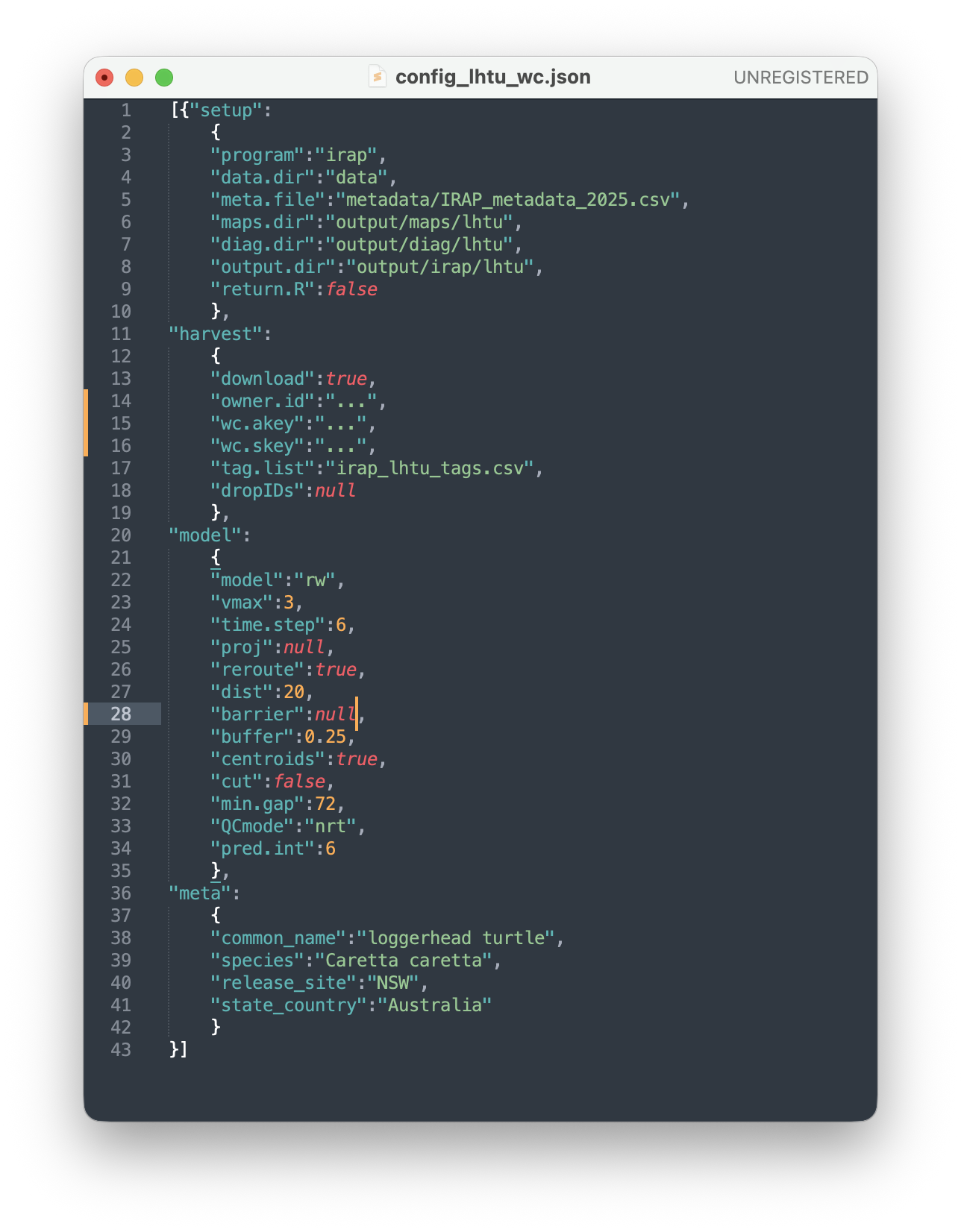
The slightly different config parameter structure accounts for differences in data structures between the 2 manufacturers’ tags. The WC config parameters are as follows:
-
setupconfig block specifies the program overseeing data assembly & paths to required data, metadata & output directories:-
programthe national (or other) program of which the data is a part. For example,imos,atn,otn. -
data.dirthe name of the data directory. Must reside within thewd. -
meta.filethe metadata filename. Must reside within thewd. Can be NULL, in which case, themetaconfig block (see below) must be present & tag-specific metadata are acquired from the WC Data Portal. -
maps.dirthe directory path to write diagnostic maps of QC’d tracks. -
diag.dirthe directory path to write diagnostic time-series plots of QC’d lon & lat. -
output.dirthe directory path to write QC output CSV files. Must reside within thewd. -
return.Ra logical indicating whether the function should return a list of QC-generated, internal R objects. This results in a single large object returned to the R work space containing the following elements:-
dropIDsthe WC uuid’s dropped from the QC process -
wcthe WC tag data files downloaded from the WC Data Portal -
metathe deployment metadata formatted for use in the QC workflow (ie. not the final output format) -
locations_sfthe projected location data to be passed as input to the SSM -
fit1the initial SSM output fit object -
fit2the final SSM output fit object including re-routed locations if specified. -
wc_ssmthe SSM-annotated WC tag data files. This output object can be useful for troubleshooting undesirable results during delayed-mode (supervised) QC workflows.
-
-
-
harvestconfig block specifies data harvesting parameters:-
downloada logical indicating whether tag data are to be downloaded from the WC Data Portal API or read from the localdata.dir. -
owner.idthe Wildlife Computers collaborator ID, which is required if the user does not own or otherwise does not have direct access to the tag data. Note, that data-sharing collaborations must be set up in the Wildlife Computers Data Portal prior to accessing via the API. -
wc.akeythe Wildlife Computers Access Key that all Portal users must have to access the API. -
wc.skeythe Wildlife Computers Secret Key. -
tag.lista .CSV file with a single variable nameduuid, providing the uuid’s to be downloaded. This ensures only the subset of desired tag datasets are downloaded. If not provided (NULL) then ALL the tag datasets attributed to theowner.idor to user providing wc-keys will be downloaded. -
dropIDsa .CSV file with a single variable nameduuid, providing the uuid’s to be ignored by the QC process. Can be NULL.
-
-
modelconfig block specifies model- and data-specific parameters:-
modelthe aniMotum SSM model to be used for the location QC - typically eitherrworcrw. -
vmaxfor SSM fitting; max travel rate (m/s) to identify implausible locations -
time.stepthe prediction interval (in decimal hours) to be used by the SSM -
projthe proj4string to be used for the location data & for the SSM-estimated locations. Can be NULL, which will result in one of 5 projections being used, depending on whether the centroid of the observed latitudes lies in N or S polar regions, temperate or equatorial regions, or if tracks straddle (or lie close to) -180,180 longitude. -
reroutea logical; whether QC’d tracks should be re-routed off of land (default is FALSE). Note, in some circumstances this can substantially increase processing time. Default land polygon data are sourced from theropensci/rnaturalearthhiresR package. -
distthe distance in km from outside the convex hull of observed locations from which to select land polygon data for re-routing. Ignored ifreroute = FALSE. -
barrieran optional filepath to an alternate polygon data file (shapefile) for the land (or other) barrier. For example, higher resolution local coastline data can be supplied, provided the data extend at leastdistkm beyond the extent of the track data. -
bufferthe distance in km to buffer rerouted locations from the coastline. Ignored ifreroute = FALSE. -
centroidswhether centroids are to be included in the visibility graph mesh used by the rerouting algorithm. See?pathroutr::prt_visgraphfor details. Ignored ifreroute = FALSE. -
cutlogical; should predicted locations be dropped if they lie within in a large data gap (default is FALSE). -
min.gapthe minimum data gap duration (h) to be used for cutting predicted locations (default is 72 h) -
QCmodeone of eithernrtfor Near Real-Time QC ordmfor Delayed Mode QC. -
pred.intthe prediction interval (in hours) to be used. Typically, this is the same as thetime.step.
-
-
metaconfig block specifies species and deployment location information. This config block is only necessary when no metadata file is provided in thesetupblock.-
common_namethe species common name (e.g., “loggerhead turtle”) -
speciesthe species scientific name (e.g., “Caretta caretta”) -
release_sitethe location where tags were deployed (e.g., “NSW”) -
state_countrythe country/territory name (e.g., “Australia”)
-
With a completed config file, the standard call to initiate the QC workflow within R is:
wc_qc(wd = "test", config = "irap_config.json")where wd is the file path for the working directory
within which all QC data/metadata inputs are downloaded (or read) and
outputs are written.
Additional details on config parameters
The Wildlife Computers API credentials: collab.id,
wc.akey, and wc.skey may be used to download
data directly from the Wildlife Computers Portal, in this case, data are
written to tag-specific directories within the specified
data.dir directory. Alternatively, wc_qc() may
be used with local copies of Wildlife Computers tag data, provided they
are stored in tag-specific directories within the data.dir
directory.
The proj argument specifies the projection (as a
proj4string) to which the tag-measured locations are
converted as input to the QC state-space model (SSM), ie. the working
projection in km for the SSM. Any valid
proj4string may be used, provided the units are in
km. If proj is left as NULL then
the QC algorithm will project the data differently depending on the
centroid latitude of the tracks. The default projections are:
| Central Latitude or Longitude | Projection (with +units=km) |
|---|---|
| -55 to -25 or 25 to 55 Lat | Equidistant Conic with standard parallels at the tracks’ 25th & 75 percentile Latitudes |
| < -55 or > 55 Lat | Stereographic with origin at the tracks’ centroid |
| -25 to 25 Lat | Mercator with origin at the tracks’ centroid |
| -25 to 25 Lat & Long straddles -180,180 | Longitudes are shifted to 0, 360 and a Mercator with origin at tracks’ centroid |
The model argument specifies the aniMotum
SSM to be used; typically either rw or crw.
The latter is usually less biased when data gaps are absent, the former
is best when data gaps are present. A general recommendation is to use
model:rw as the SSM for unsupervised (e.g.,
NRT) QC workflows. The SSM fitting algorithm has a few fundamental
parameters that need to be specified; vmax is the animals’
maximum plausible travel rate in
ms.
For example, vmax:3 is usually appropriate for
seals and vmax:2 for turtles. The SSM
prediction interval in hours is specified with time.step.
Decimal hours can be used for time.steps shorter than 1 hr.
This time interval determines the temporal resolution of the predicted
track. The predicted track locations provide the basis for interpolation
to the time of each tag-measured ocean observation or behavioural event.
Typically, 6 hours is appropriate for most Argos data collected from
seals and turtles but a finer time interval may be required for faster
moving species and/or more frequently measured ocean observations, and a
coarser interval for more sporadically observed locations. Further
details on SSM fitting to Argos and GPS data are provided in the
associated R package aniMotum vignettes and
in Jonsen
et al. 2023.
When animals pass close to land some SSM-predicted locations may
implausibly lie on land. Often, this is due to the spatial and temporal
resolution of the Argos tracking data. In these cases, SSM-predicted
locations can be adjusted minimally off of land by setting
reroute:true. The pathroutr R
package is used for efficient rerouting. In this case, additional
arguments should be specified:
dist - the distance in km beyond track locations from
which coastline polygon data should be sampled (smaller provides less
information for path re-routing, greater increase computation time)
barrier - an optional parameter that can provide an
alternate spatial polygon dataset , as a shapefile, for the land (or
other barriers to movement). Typically, this alternate dataset would be
a localised, high-resolution coastline dataset.
buffer - the distance in km to buffer rerouted locations
from the coastline
centroid- whether to include the visibility graph
centroids for greater resolution
SSM-predicted tracks can be cut
(cut:true) in regions where large location
data gaps exist. These location data gaps can occur when the tags are
unable to transmit for extended periods or when animal surfacing occurs
during periods of Argos satellite unavailability (more common closer to
the equator than at higher latitudes). In this case,
min.gap is used to specify the minimum data gap duration
(h) from which to cut SSM-predicted locations. This will limit
interpolation artefacts due to implausible SSM-predicted locations in
excessively long data gap periods.
The QCmode sets whether the QC is being conducted in
delayed-mode dm or near real-time nrt.
Delayed-mode is reserved for when tag deployments have ended and usually
involve greater user intervention; such as making decisions on removing
aberrant portions of a deployment (e.g., as tag batteries begin
failing). The nrt mode is meant to be fully automated and
only used while a deployment is active. In both cases, the output .CSV
and plot file names will include the QCmode as a
suffix.